Context#
The İş Bankası Museum tells the story of Türkiye İş Bankası — its founding, its founders, its growth across the country, and its role in supporting young entrepreneurs and new ventures over the decades.
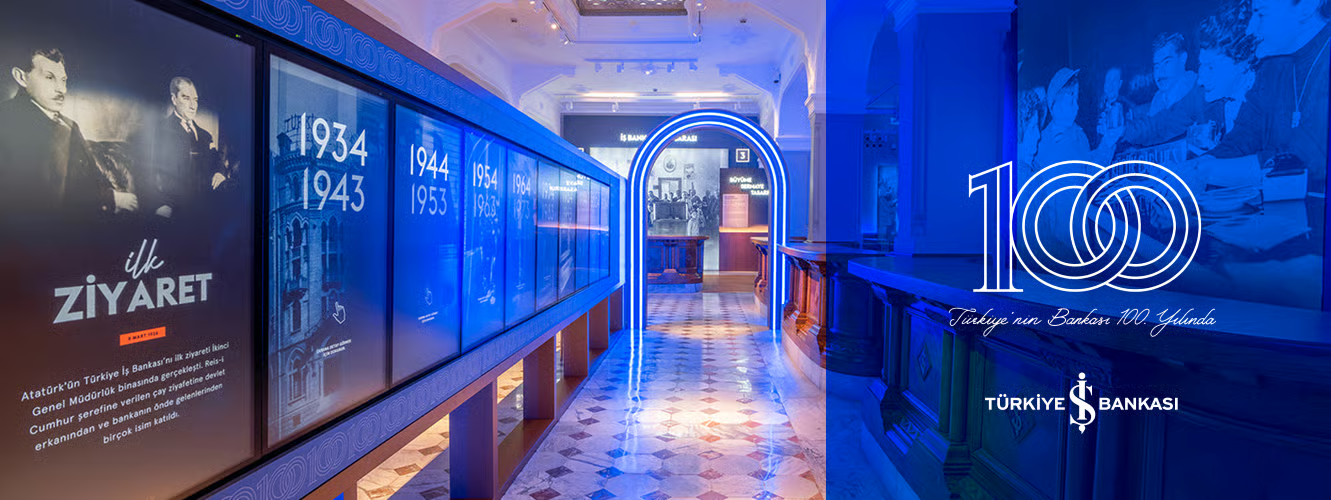
This exhibition is the history piece of that story. A row of fourteen touchscreens lines a wall of the museum, and together they walk a visitor through the bank's history one decade at a time. You move from screen to screen, and the country's century moves with you.
It was commissioned directly by Türkiye İş Bankası and delivered in August 2024. It is installed and running in the museum now.
This was also my first museum installation project.
How It Works#
The exhibition is built around fourteen side-by-side touchscreens, each running on a BrightSign device — a piece of hardware purpose-built for interactive signage. Each screen is a self-contained piece of the larger story.
Most of the screens are timeline screens. Each one covers a decade of the bank's history. A visitor walks up, touches a moment on the screen, and a video plays or a still appears with information about that event.
Three screens break the timeline pattern and serve different roles.
One is the founders screen. It shows the people behind the bank's founding — touch a founder and the screen shows who they were and what they did.
One is the network screen. A map of Türkiye runs on it, looping through the years and showing the bank's branch network growing across the country. Touch a year and the screen shows the branches that existed then — the bank spreading across the map decade by decade.
One is the ventures screen, covering the bank's investments and support for new businesses and entrepreneurs. Touch a venture, a video plays.
Across all fourteen screens, the interaction is the same: touch, and something unfolds. The hardware is BrightSign's; the content and its behavior are built on top.
Approach#
The exhibition came together as a three-person team, with the work split across roles. I worked on the development side — building the interactive layer that runs on the BrightSign devices.
The technology stack is deliberately not a game engine. BrightSign devices run web content natively, and the exhibition is built with plain HTML, CSS, and JavaScript. No framework, no engine — just the web platform, optimized to run reliably on dedicated signage hardware. The touch interactions, the video playback, the timeline navigation, the map loop — all of it is written as straightforward interactive web pages, tailored to the BrightSign environment.
Some of the video content was produced by Kabuk Studio. The rest of the assets, the structure of each screen, the interactions, and the orchestration across fourteen devices were the work of the team.
Tech Stack#
The exhibition runs on BrightSign hardware — interactive signage devices designed for this kind of always-on, public-facing setup. The content layer is built with plain HTML, CSS, and JavaScript, with no framework. Video content includes pieces produced by Kabuk Studio. Fourteen BrightSign units are deployed side by side, each running its own page of the exhibition.
Visuals#
Videos#
Outcome#
The exhibition was delivered in August 2024. It is installed in the İş Bankası Museum and running for visitors today.
This was my first museum installation, and it shaped everything that came after. Working on fourteen coordinated screens, on dedicated signage hardware, for a public-facing exhibition with a national institution as the client — that is a different kind of project than building software for a screen on your desk. The work has to be quiet, dependable, and ready for a visitor who does not care how it was made.
The Istanbul Archaeology Museum touchwall that followed was possible because of what this project taught — about the discipline of installation work, about content review cycles, about building for hardware that has to stay alive on its own. Different stack, different hardware, same lesson: in installation work, the bar is that it runs.