Context#
The Istanbul Archaeology Museum opened a new building for the civilizations of Egypt, Mesopotamia, and Anatolia. One wall of that space is not a wall in the usual sense — it is an interactive surface where visitors touch history into motion.
The touchwall covers the defining moments of those civilizations: the first pyramid, the Assyrian Empire, the Epic of Gilgamesh, Alexander the Great, the Treaty of Kadesh, the invention of the potter's wheel. A visitor walks up, touches the region tied to one of these events, and an animation begins — visuals and text unfolding the story of when it happened and what it meant.
This was commissioned for the Republic of Türkiye's Ministry of Culture and Tourism. It is installed and running in the museum now.
How It Works#
There is no screen. The image is projected.
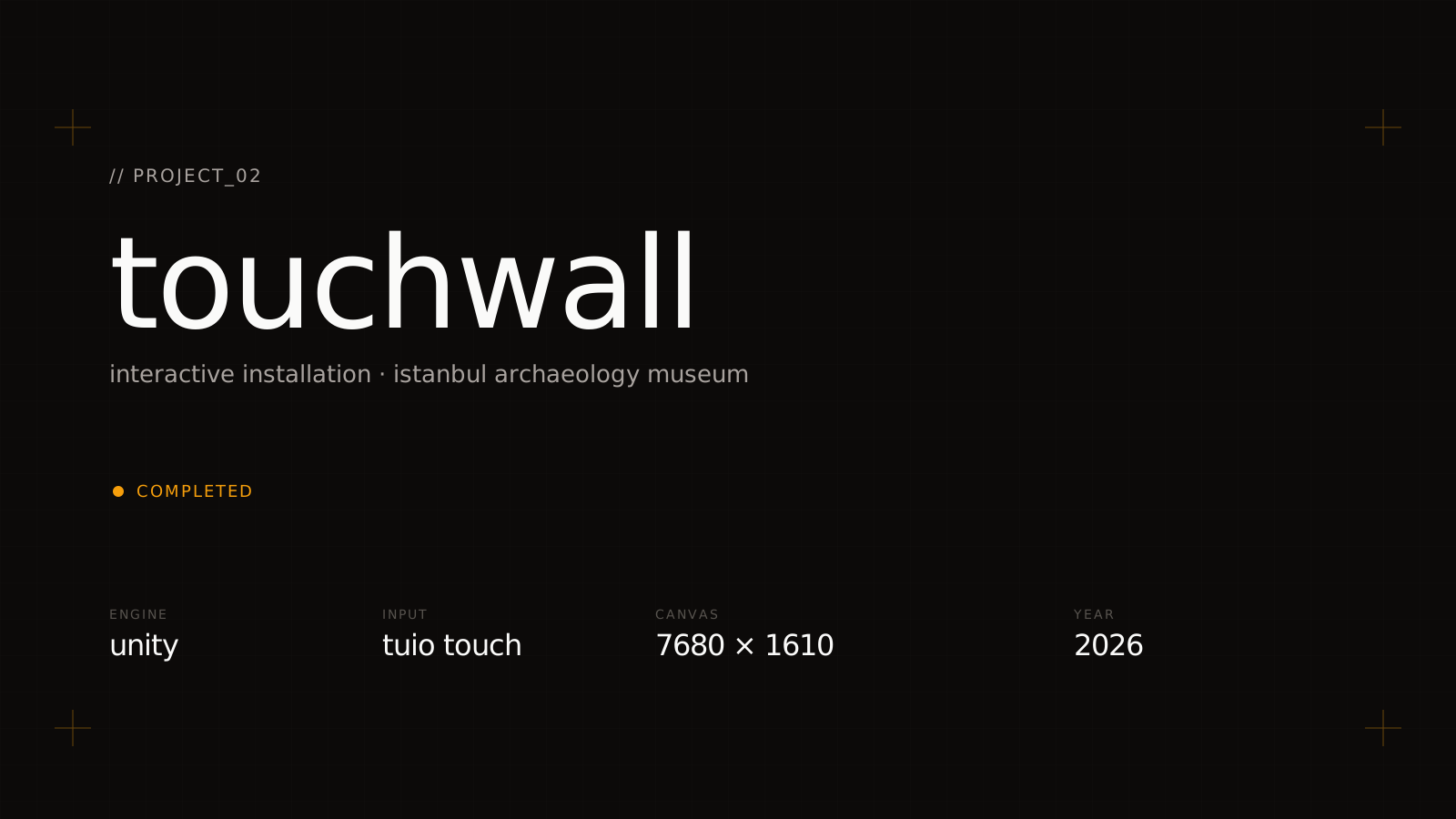
Two projectors are edge-blended into a single seamless canvas at 7680×1610, cast directly onto the wall. Touch sensing is layered on top: the surface is divided into addressable regions, and a TUIO-based touch system maps where a visitor touches the projected image to the interactive content behind it.
When a touch lands on a region, it triggers the content tied to that moment in history — an animation plays, text appears, and the story of that event unfolds on the wall.
Approach#
The project came together as a collaboration between three parties, each owning a distinct part.
Content — Kabuk Studio#
All visual content was produced by Kabuk Studio, our content partner. The animations and stills for each historical event — the pyramids, the empires, the epics — were delivered as PNG and MP4 assets, designed for the scale and tone of the exhibition.
Unity integration — the interactive layer#
My part was the interactive system in Unity. I took Kabuk Studio's PNG and MP4 assets and built the experience around them in C# — assembling the content, wiring the TUIO touch input to the right regions of the projected canvas, and triggering the correct animation and text when a visitor touches a given moment in history.
The touchwall has to read correctly across a 7680×1610 projected canvas, with touch regions aligned precisely to where the visuals sit on the wall.
Reliability — GoodBoi Agent#
A museum installation runs unattended, all day, every day. If it crashes, a wall of the exhibition goes dark and no one notices until a visitor walks up to nothing.
That requirement is exactly why GoodBoi Agent exists. GoodBoi supervises the touchwall application, keeps it alive, and monitors the machine it runs on — the installation manages itself so the museum does not have to.
Tech Stack#
The interactive layer is built in Unity with C#. Touch input runs through a TUIO-based system that maps touches on the projected surface to addressable content regions. The display is a 7680×1610 canvas produced by edge-blending two projectors — no physical screen. Visual content (PNG stills and MP4 animations) was created by Kabuk Studio. Reliability and uptime are handled by GoodBoi Agent, which supervises the application and the machine.
Visuals#
Outcome#
The touchwall was delivered in May 2026, after development that began in September 2025. It is installed and running in the Istanbul Archaeology Museum's new civilizations building, where visitors interact with it every day.
Museum installation work is demanding in a way ordinary software is not. Content goes through round after round of revision before it is approved — the bar for something that will be seen by this many people, in a national museum, is high. And because the installation runs unattended and continuously, reliability is not a feature, it is the requirement. That is the part of this project I am most aware of: it is real, it is public, and a great many people will touch this wall.